
Quick answer: Your website is probably not blocking ChatGPT through its robots.txt file. When I tested 25 plumbers’ websites on 11 November 2026, only one of the 23 sites I could judge turned away an AI search bot, and every block I found came from a firewall, not robots.txt. Test your own site to be sure.
On 11 November 2026, I ran the homepages of 25 plumbers through my free AI Visibility Check, one site at a time, to see who turns ChatGPT away. I expected a long list. Of the 23 sites the tool was able to judge, one refused an AI search bot, the kind of crawler OpenAI says it uses to surface websites in ChatGPT search.
Four sites refused at least one AI bot, and all four refusals came from the firewall layer. Only one of those four also had a robots.txt rule, and it covered training bots only. The bigger gap sat somewhere else: only 9 of the 23 sites carried complete business details in their page code. That was the finding I did not expect, and it changed what I would check first.
If you own a business, the real problems here are quiet. A bot-protection setting at your host can turn a crawler away while your robots.txt file says the opposite, and nothing on your screen tells you. So the honest answer to “is my website blocking ChatGPT” is usually quieter than people expect. The numbers below show what I saw.
How I Ran the Test
I searched Google Maps for “plumber” in five US cities: Pittsburgh, Charlotte, Columbus, Dallas and Denver. In each city I took the top-ranked listings that had a website, five per city. I skipped sponsored ads, national franchise brands, directories and listings with no website. Then I ran each homepage through the tool, six seconds apart, and used the second of two runs made a few minutes apart.
The tool does four things for every site:
- Loads the homepage like a normal browser. This is the control.
- Reads robots.txt for 13 crawlers, including OAI-SearchBot, GPTBot, ClaudeBot, Claude-SearchBot and PerplexityBot.
- Fetches the homepage again under the names of seven bots and compares each answer with the control.
- Checks the page for readable text, business details in the code, and a sitemap.
This is not a random sample. It is 25 top-ranked listings in one trade across five cities, so every count below describes these sites and nothing wider.
What the Numbers Say
Two of the 25 sites refused even the normal browser, so no bot was judged on them. That left 23 sites. Here is what I saw on those 23:
- 22 had no robots.txt rule blocking any AI bot. The one that did (Plumber 04, Pittsburgh) blocked five training bots and no search bot.
- 4 refused at least one AI bot on the live fetch, with an HTTP 403 error while the browser got the page.
- 1 refused AI search bots (Plumber 16, Dallas): OAI-SearchBot, Claude-SearchBot and PerplexityBot all got a 403.
- 19 left every AI bot I tested fully open.
- Scores ran from 80 to 99 out of 100, with a median of 94.
So, is my website blocking ChatGPT? In this sample, for 22 of 23 sites the answer was no at the robots.txt level. The scary version of this story says most small business sites lock AI out. In my sample, that did not happen.
Firewall or robots.txt: Where the Blocks Came From
Every refusal came from the live fetch, where the server answered a bot with an error. The one robots.txt block covered training bots, and no robots.txt rule was aimed at a search bot. The tool reads that as a firewall or CDN rule. I cannot see inside those hosts, so treat that as the tool’s reading, not a confirmed cause.
Three sites stood out:
- Plumber 13, Columbus. The robots.txt file had its own Allow rule for GPTBot and ClaudeBot, yet the server refused ClaudeBot. The file and the server disagreed.
- Plumber 16, Dallas. Every bot name I tried got a 403, including Googlebot and Bingbot, while the browser got the page. The robots.txt file was 19 bytes long and had no rules. That pattern looks like a rule on bot names, though I cannot prove it.
- Plumber 04, Pittsburgh. The robots.txt file blocked five training bots, and the firewall also refused GPTBot and ClaudeBot. Search bots got in, and the site scored 98.
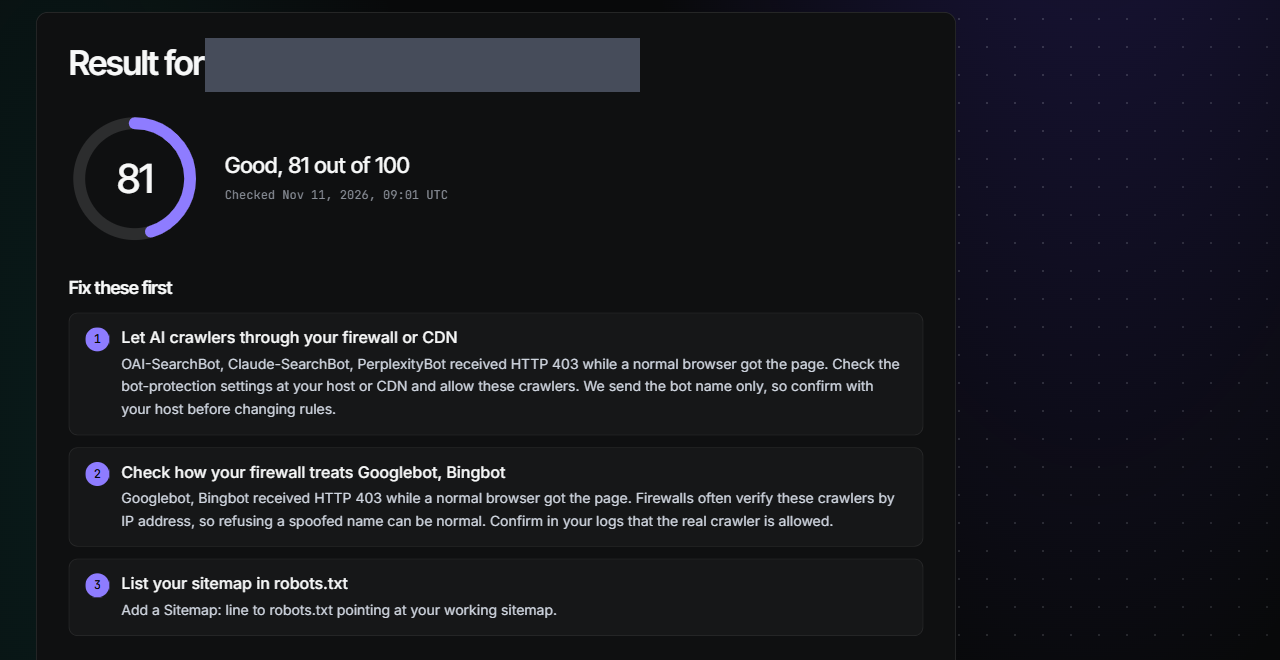
Why does this matter? OpenAI recommends allowing OAI-SearchBot in robots.txt and allowing requests from its published IP ranges. A robots.txt file alone does not settle it. A firewall that refuses the bot never reads the file.
There is a counterweight, and the tool states it plainly. Cloudflare explains that its verified bots are identified by a published IP list with a stable user-agent, or reverse DNS. So a firewall that refuses a fake Googlebot name can be doing its job. I send the bot name from my own server, which is why a block in my results is a strong signal and not proof.
Site-by-Site Results
Here is every site I tested, anonymised to a number and a city. The two sites with no score refused the normal browser, so I did not blame any bot.
| Site | City | Score | AI search bots | AI training bots | Where a block came from | Business details |
|---|---|---|---|---|---|---|
| Plumber 01 | Pittsburgh | 99 | Open | Open | No block | Complete |
| Plumber 02 | Pittsburgh | 99 | Open | Open | No block | Complete |
| Plumber 03 | Pittsburgh | 93 | Open | Open | No block | Incomplete |
| Plumber 04 | Pittsburgh | 98 | Open | Blocked (5 of 5) | robots.txt and firewall | Complete |
| Plumber 05 | Pittsburgh | 99 | Open | Open | No block | Complete |
| Plumber 06 | Charlotte | 95 | Open | Open | No block | Incomplete |
| Plumber 07 | Charlotte | 89 | Open | Open | No block | Missing |
| Plumber 08 | Charlotte | 98 | Open | Open | No block | Complete |
| Plumber 09 | Charlotte | 89 | Open | Open | No block | Incomplete |
| Plumber 10 | Charlotte | 95 | Open | Open | No block | Incomplete |
| Plumber 11 | Columbus | No score | Not judged | Not judged | Normal browser refused too | Not judged |
| Plumber 12 | Columbus | 89 | Open | Open | No block | Missing |
| Plumber 13 | Columbus | 94 | Open | Blocked (1 of 5) | Firewall only | Incomplete |
| Plumber 14 | Columbus | 93 | Open | Open | No block | Incomplete |
| Plumber 15 | Columbus | 98 | Open | Blocked (2 of 5) | Firewall only | Complete |
| Plumber 16 | Dallas | 81 | Blocked (3 of 3) | Blocked (2 of 5) | Firewall only | Complete |
| Plumber 17 | Dallas | No score | Not judged | Not judged | Normal browser refused too | Not judged |
| Plumber 18 | Dallas | 88 | Open | Open | No block | Missing |
| Plumber 19 | Dallas | 94 | Open | Open | No block | Incomplete |
| Plumber 20 | Dallas | 94 | Open | Open | No block | Incomplete |
| Plumber 21 | Denver | 80 | Open | Open | No block | Missing |
| Plumber 22 | Denver | 90 | Open | Open | No block | Missing |
| Plumber 23 | Denver | 99 | Open | Open | No block | Complete |
| Plumber 24 | Denver | 94 | Open | Open | No block | Incomplete |
| Plumber 25 | Denver | 99 | Open | Open | No block | Complete |
Table built from the results of my 11 November 2026 run. Bold rows are the four sites that refused an AI bot. The training bots in the tool are GPTBot, ClaudeBot, Google-Extended, CCBot and Applebot-Extended.
The Bigger Gap Was Business Details
The tool also looks for business details in the page code: a name, website, address and phone number. On the 23 judged sites, 9 had them complete, 9 had them incomplete and 5 had none. Access was fully open on 19 of 23, so the details gap was more than twice the size of the access gap.
I need to be careful here. Google says “You don’t need to create new machine readable files, AI text files, or markup to appear in these features”, and that there is no special schema.org structured data to add. That statement covers Google’s AI features, not ChatGPT, and I have no test showing that complete details change what ChatGPT says about a business. What I can say is narrower: it was the largest gap I measured, and it is a small job.
If your question is the wider one, why a competitor gets named in AI answers and your business does not, I covered what I could see from the outside in why a competitor shows up in Google’s AI answers.
What This Check Cannot Prove
A test like this goes wrong in predictable ways, so here are its limits.
The bot name comes from my server, not from the bot’s real network. Some firewalls verify real bots by IP address, so the real crawler is treated differently from my copy of its name. The tool fetches the homepage only. It runs live fetches for 7 of the 13 bots, and the other six are robots.txt only. It also cannot tell you whether ChatGPT mentions your business.
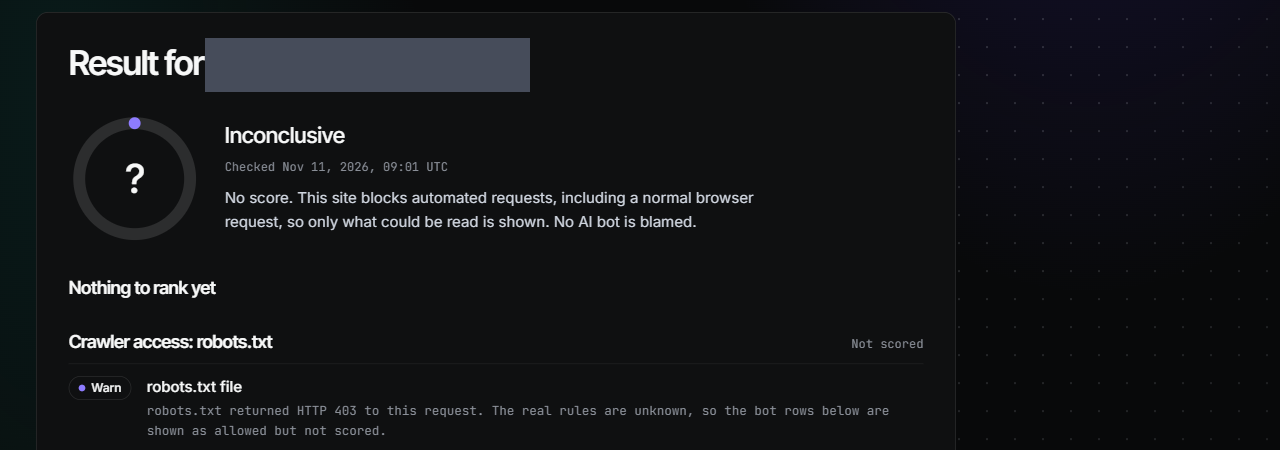
Two sites were out of reach entirely. Plumbers 11 and 17 answered even the normal browser with a 403 page that said the visitor was being checked. The tool marked them inconclusive and blamed no bot. I think that is the honest result, since a site that refuses everyone cannot be said to refuse ChatGPT in particular.
What I Would Check First
These are my opinions, and each one comes from the numbers above, not from a general rule.
- Check the firewall before you rewrite robots.txt. In my sample, 22 of 23 robots.txt files blocked no AI bot, and all four refusals came from the server. Ask your host or CDN provider whether bot protection is on and whether OAI-SearchBot, Claude-SearchBot and PerplexityBot are allowed.
- Treat a training-bot block as a policy choice. Plumber 04 blocked five training bots and scored 98, because the tool does not penalize that choice. OpenAI says each of its bot settings is independent, so blocking GPTBot does not block OAI-SearchBot. Decide it on principle, not out of fear.
- Fill in your business details before the rest of the list. It was the biggest gap I measured. I would not promise you it changes AI answers.
- Leave llms.txt for last. My tool does not score it, Google says no AI text files are needed for its features, and my own site has none. Twelve of the 25 plumbers did have one, and I am not telling anyone to remove it.
I would not rewrite robots.txt if your check shows the file open and the server refusing. That is exactly the situation Plumber 13 was in.
Check Your Own Site Before You Change Anything
Is my website blocking ChatGPT? You can find out for your own site in 30 seconds. Paste your homepage into the free AI Visibility Check. The check needs no sign-up and shows the evidence line for every result, so you can confirm it yourself. An inconclusive result means your site refuses automated requests in general. It does not mean ChatGPT is blocked. If a search bot shows a 403, send that result to your host and ask them to confirm.
If you would rather see how a competitor gets named in search and AI answers while your business does not, I will build you a free Visibility Breakdown: one dated page, built around one real search.
Frequently Asked Questions (FAQs)
How do I check if my website is blocking ChatGPT?
Run your homepage through a check that fetches it as a normal browser and then as each bot, and compare the answers. Read your robots.txt file as well. If the bots get an error while the browser gets the page, the block sits in your firewall or host, not in the file.
Does ChatGPT crawl my website?
Yes, through several bots with different jobs. OpenAI says OAI-SearchBot surfaces sites in ChatGPT search, GPTBot crawls content that is used for training, and ChatGPT-User visits a page when a person asks about it. Each one is set separately in robots.txt, so allowing one says nothing about the others.
Should I block GPTBot?
Blocking GPTBot is a choice about training, not about being found. OpenAI states that disallowing it signals your content should not be used to train its models, and that setting is independent of OAI-SearchBot. In my test, one site blocked training bots only and still scored 98.
Why would a firewall block a bot that robots.txt allows?
They are two separate layers. The robots.txt file is a request that a bot reads, while a firewall refuses the visit before any file is read. In my test, one robots.txt had an explicit Allow for ClaudeBot while the server answered ClaudeBot with an error. I cannot see inside that host to say why.
Does blocking OAI-SearchBot keep my business out of ChatGPT?
It keeps the site out of ChatGPT search answers, according to OpenAI. The company states that sites opted out of OAI-SearchBot will not be shown in those answers, though they can still appear as navigational links. Only 1 of the 23 sites I could judge refused an AI search bot.